October 4, 2013

Vo Nguyen Giap, renowned Vietnamese general, dies in Hanoi


Vo Nguyen Giap, the Vietnamese military commander and national folk hero who organized the army that defeated the French and then the Americans in 30 years of Southeast Asian warfare, is dead. That war ended in 1975 when the last remaining U.S. military forces evacuated Saigon, leaving behind a war-torn and battle-scarred nation, united under Communist rule.
He died Oct. 4 in a hospital in Hanoi, a government official told the Associated Press. He was 102. No cause of death was immediately reported.
Gen. Giap was the last survivor in a triumvirate of revolutionary leaders who fought France’s colonial forces and then the United States to establish a Vietnam free of Western domination. With the Vietnamese Communist leader Ho Chi Minh, who died in 1969, and former prime minister Pham Van Dong, who died in 2000, Gen. Giap was venerated in his homeland as one of the founding fathers of his country. To military scholars around the world, he was one of the 20th century’s leading practitioners of modern revolutionary guerrilla warfare.
From a ragtag band of 34 men assembled in a forest in northern Vietnam in December 1944, Gen. Giap built the fighting unit that became the Vietnam People’s Army. At the beginning, its entire supply of weapons consisted of two revolvers, one light machine gun, 17 rifles and 14 flintlocks, some of them dating to the Russo-Japanese War of 1904-05, said Cecil B. Currey, Gen. Giap’s biographer.
But the original 34 men took a solemn oath to fight to the death for a Vietnam independent of foreign rule, and they promised not to help or cooperate with colonial or any other foreign authorities. By August 1945, when the surrender of Japan ended World War II, they had become an army of 5,000, equipped with American weapons supplied by the U.S. Office of Strategic Services, the precursor of the CIA, to use against the Japanese who had occupied Vietnam.
For almost three decades, Gen. Giap led his army in battle against better-supplied, better-equipped and better-fed enemies. In 1954, he effectively ended more than 70 years of French colonial rule in Indochina, dealing a humiliating defeat to a French garrison in a 55-day siege of the mountain-ringed outpost at Dien Bien Phu. To millions of Vietnamese, this was more than a military victory. It was a moral and psychological triumph over a hated colonial oppressor, and it earned Gen. Giap the status of a national legend.
Twenty-one years later, on April 30, 1975, came the fall of Saigon, the capital of South Vietnam. This ended a prolonged and bitter war between Vietnamese communists, based in the north, and the U.S.-supported government of South Vietnam, which was based in Saigon and backed by the military might of the world’s greatest superpower.
In an internal power struggle three years earlier, Gen. Giap was replaced as field commander of the communist forces, and in 1975 he watched from the sidelines as the army he created and nurtured took the enemy capital. Nevertheless, 25 years later, he would recall the fall of Saigon as the “happiest moment in this short life of mine.”
With the capture of Saigon, Vietnam was united under a single governmental authority for the first time since its partition into North and South Vietnam after the 1954 French defeat. Gen. Giap was defense minister in the Communist government that ruled the new Vietnam and a member of the powerful politburo.
But it was as a military leader that he made his mark on history.
In the course of his career, Gen. Giap commanded millions of men in regular army units, supplemented by local militia and self-defense outfits in villages and hamlets throughout Vietnam. He journeyed to the remotest areas of his country on recruiting missions, and he learned the art of combat the old-fashioned way — by fighting.
He waged all manner of warfare: guerrilla raids, sabotage, espionage, terrorism and combat on the battlefield, and he involved as much of the civilian population in this effort as he could. Peasant women carried concealed arms, ammunition and supplies to hiding guerrilla soldiers. Children passed along information about troop movements through their villages. Everyone was a lookout for enemy aircraft.
“All citizens are soldiers. All villages and wards are fortresses, and our entire country is a vast battlefield on which the enemy is besieged, attacked and defeated,” Gen. Giap was quoted as saying.
To survive, he had to be flexible and adaptable, and he was. Facing an overpowering array of U.S. bombs and artillery, he employed a tactic that was sometimes likened to a boxer’s grabbing an opponent by the belt and drawing him too close for his punches to be effective. In close combat, the bombs and artillery shells of his enemy would be of limited use, but Gen. Giap’s men, operating in small units, could fight more effectively.
In the end, Gen. Giap would outlast his enemies. The French grew tired of paying the price of fighting him in Southeast Asia, and so did the United States, after 58,000 American deaths in a war that promised no more than a stalemate.
He said: “The United States imperialists want to fight quickly. To fight a protracted war is a big defeat for them. Their morale is lower than grass. . . . National liberation wars must allow some time — a long time. . . . The Americans didn’t understand that we had soldiers everywhere and that it was very hard to surprise us.”
To at least one U.S. military commander, this strategy was apparent even in the early years of American involvement in the hostilities. Marine Corps Gen. Victor Krulak, in a 1966 memorandum to President Lyndon B. Johnson and Defense Secretary Robert S. McNamara, wrote that Gen. Giap “was sure that if the cost in casualties and francs was high enough, the French would defeat themselves in Paris. He was right. It is likely that he feels the same about the USA.”
A master of military logistics and administration, Gen. Giap directed construction, maintenance and operation of the Ho Chi Minh Trail, down which a steady stream of men and arms flowed from North Vietnam to support the war in the South.
Under his command, a corps of 100,000 Vietnamese and Laotian laborers slogged under 70-pound packs through swamps and jungles, up and down mountains to deliver the supplies, weapons and ammunition to fuel the fight. From a network of mountain footpaths used by peasants and travelers for centuries, they built a 12,000-mile system of camouflaged roadways and spurs, much of it in the neutral territory of Laos. Some sections were two-lane paved roads, capable of handling tanks and heavy trucks. Others were primitive dirt roads. There were air raid shelters, rest stops and bridges. All of it demanded unremitting repair and upkeep.
Gen. Giap was a hard-line and tenacious Communist, and one of the early members of the Vietnamese Communist Party, which was founded by Ho in 1930. In the late 1940s, he led a program aimed at eradication of non-communist political organizations in Vietnam that is said to have caused the death of thousands. One technique of this campaign was to tie opponents together in batches like cordwood, then throw them into the Red River and let them drown while floating out to sea. This was known as “crab fishing.”
From a manpower base of peasant farmers, Gen. Giap constructed a paramilitary guerrilla force, which he then transformed into an army of fully trained soldiers through a combination of rigorous training and political indoctrination.
In three decades of combat, he is said to have had more than a million of his soldiers killed, a casualty level that would have cost any U.S. general his command. “Every minute hundreds of thousands of people die all over the world. The life or death of a hundred, a thousand or tens of thousands of human beings, even if they are our own compatriots, represents really very little,” the French writer Bernard B. Fall quoted him as saying.
Metaphorically, Gen. Giap was described in Vietnamese as “Nui Lua,” which means roughly “volcano beneath the snow.” On the surface, his personality was cold and arrogant, but he was seething on the inside and capable of fearsome explosions. Colleagues said he was impatient, dogmatic, energetic and loyal to his friends.
He was ambitious and not above personal vanity. To several interviewers, he suggested that he could be considered an Asian Napoleon. Time magazine, in a 1968 article, described him as a “dangerous and wily foe . . . a tactician of such talents that U.S. military experts have compared him with German Field Marshal Erwin Rommel.”
Vo Nguyen Giap was born Aug. 25, 1911, in the province of Quang Binh in an area of central Vietnam, which, with Laos and Cambodia, was then part of the French protectorate of Indochina. His native village of An Xa consisted primarily of straw and bamboo huts, alongside a few tile-roofed buildings. As a boy, he attended local public schools, where his teachers beat him with a thin bamboo stick whenever he faltered in his lessons.
At age 12, he failed the first examination that would have allowed him additional schooling. French colonial authorities discouraged advanced education throughout Indochina, knowing that an ignorant population would be easier to control. But the young Vo Nguyen Giap spent the next year in intensive study, and on his second try, he passed the exam that allowed him to attend secondary school in Hue.
There, in 1926, the future general read a book that would change his life and influence the history of Southeast Asia. Its title was “Colonialism on Trial,” written by Ho Chi Minh. Gen. Giap would recall years later that Ho’s book triggered in him an abiding hatred of the French, and it launched him on the revolutionary journey that would become his life’s work.
He read other writings of Ho and studied the works of Karl Marx and Vladi­mir Lenin, organized an underground reading library and in 1927 was expelled from school for organizing a strike in support of a student who he was sure had been falsely accused of cheating. He wrote under pseudonyms for a reform-minded newspaper, became active with the Communist Party and was jailed for revolutionary activities from 1930 to 1932.
On his release, he won a scholarship for a school in Hanoi and received a baccalaureate degree in 1934. Later he taught history and French at a private school in Hanoi, and he was admitted to the French-managed University of Hanoi’s law school, where he received a doctorate in 1938.
In 1939 he married Quang Thai, a fellow member of the Communist Party, whom he had met in prison years earlier. She gave birth to their daughter, Hong Anh, in January 1940. Four months later, the central committee of the Communist Party decided to send him to join Ho, who was then living in exile in China, where he was preparing plans for the revolution he intended to launch.
Soon after Gen. Giap left for China, his wife was taken into custody by French authorities and held in a prison facility that would become known 30 years later in the United States as the “Hanoi Hilton,” where downed American fliers were held as prisoners of war. Quang Thai would die in prison, either by suicide or while being tortured. Since her arrest, their daughter had been cared for by Gen. Giap’s parents. But not until late in World War II did Gen. Giap learn of his wife’s death. In 1947, his father would also die while in French custody, refusing to publicly denounce his son, although he never agreed with his communist ideology.
“He carries in his soul wounds that even time cannot heal,” Hong Anh told Currey in a 1988 questionnaire, speaking of her father.
In the spring of 1941, Ho and Gen. Giap had returned to Vietnam from China. At a remote hamlet called Pac Bo, Ho convened a meeting of the central committee of the Vietnamese Communist Party and created the organization that would become known as the “Viet Minh,” to wage a war of independence against the French and the Japanese, who had occupied Vietnam after France fell to Nazi Germany early in World War II. Also to be eliminated were the Vietnamese “jackals” who collaborated with the enemy.
During the war years, Gen. Giap began traveling regularly to the hamlets and settlements of the Vietnamese countryside, laying the recruiting groundwork for the army he intended to raise. In July 1944, after the collapse of the Nazi collaborationist government of Vichy France, he wanted to launch an armed insurrection in Vietnam, but Ho vetoed the idea. The time was not ripe for open rebellion, he said.
But with the end of World War II in 1945, it was possible to begin guerrilla operations against the French, who returned to Vietnam expecting to reclaim their colony.
Throughout the late 1940s, Gen. Giap orchestrated hit-and-run operations against French forces. His plan was to entice the enemy to expend valuable energy in fruitless pursuit of an elusive quarry in remote areas or tie him down in an unproductive or static position. “Use the feint, the ambush, the diversionary outrage,” he wrote in a training manual adapted from the Chinese Communist leader Mao Zedong. “The enemy may outnumber you ten to one strategically, but if you compel him to disperse his forces widely, you may outnumber him ten to one locally wherever you choose to attack him.”
His army suffered heavy casualties in the Red River offensive against the French in 1951, but the Viet Minh regrouped and vanquished the French at Dien Bien Phu in 1954. Just a month before that siege ended, top French military officials traveled to Washington, hoping for a pledge of U.S. assistance. There, on April 7, 1954, President Dwight D. Eisenhower declared: “You have a row of dominoes set up and you knock over the first one, and what will happen to the last one is the certainty that it will go over very quickly. . . . The loss of Indochina will cause the fall of Southeast Asia like a set of dominoes.”
No U.S. assistance was given to the French at Dien Bien Phu, but the domino theory that Eisenhower had articulated in response to the French request would influence U.S. military policy in that part of the world for the next two decades.
At the Geneva Conference that followed the Battle of Dien Bien Phu, Vietnam was divided into two countries: north and south. In the north, the Communist Party ruled under the leadership of Ho. With the French colonialists out of the picture, an ambitious land-reform program was undertaken, for which Gen. Giap would later apologize. “[W]e . . . executed too many honest people . . . and, seeing enemies everywhere, resorted to terror, which became far too widespread. . . . Worse still, torture came to be regarded as a normal practice,” he was quoted as having said by Neil Sheehan in his Pulitzer-winning 1988 book, “A Bright Shining Lie.”
In the south, the United States replaced France as the major foreign influence. CIA operatives worked to blunt communist initiatives, and by the early 1960s, U.S. soldiers began arriving as “advisers” to the Army of the Republic of Vietnam. Men and supplies flowed southward from Hanoi, and indigenous guerrilla units throughout South Vietnam began raiding government troops and installations. The United States increased its level of support, which by 1968 had reached 500,000 military personnel.
Arguably, the turning point of the war came during the 1968 Tet Offensive, which was orchestrated by Gen. Giap. To launch this campaign, he had directed the movement of 100,000 men and tons of supplies to strategic points throughout South Vietnam. On Jan. 30, communist forces attacked 40 provincial capitals and major cities, including an unsuccessful but widely publicized assault on the U.S. Embassy in Saigon. The offensive failed militarily, Gen. Giap’s forces suffered heavy casualties and a hoped-for civilian uprising against the U.S.-backed government of South Vietnam did not happen.
But politically, the offensive was devastating in the United States, where it shattered public confidence in U.S. policy and led Johnson to decide against seeking reelection as president.
In the next four years, Gen. Giap orchestrated guerrilla raids by small units against South Vietnamese and U.S. forces. In the spring of 1972, he was relieved of his command after his Easter offensive failed in the face of massive U.S. attacks, which included the bombing of North Vietnam and the mining of Haiphong Harbor. Viet Cong and North Vietnamese losses were said to have included more than 100,000 fatalities. Gen. Giap retained his position as defense minister, but command of the Vietnam People’s Army passed to longtime disciple Van Tien Dung.
U.S. involvement in the war officially ended in January 1973 with the signing of peace accords and the withdrawal of American military forces. Without U.S. support, the South Vietnamese military collapsed in two years.
“American soldiers were just like any others,” Gen. Giap said years later in response to a question from a former U.S. service member. “When led well, they fought well.” Rarely, if ever, did the general comment publicly on the millions of Vietnamese boat people who fled the country after the communist takeover or the stagnation of the economy under Communist Party leadership.
After 1975, Gen. Giap faded from the public scene. He resigned as defense minister in 1980 and was dropped from the politburo in 1982. He continued to lead ceremonial functions and lived in comfort in a government-assigned villa in Hanoi. In 1992, he was awarded Vietnam’s highest honor, the Gold Star Order, for contributions to “the revolutionary cause of party and nation.”
In 1946, after the death of his first wife, Gen. Giap married Dang Bich Hai, the daughter of a former professor and mentor. They had two daughters, Vo Hua Binh and Vo Hahn Phuc, and two sons, Vo Dien Bien and Vo Hoai Nam.

By Bart Barnes


Women take 64% seats in Parliament


The just-concluded parliamentary elections have handed women an overwhelming majority in Rwanda’s Parliament, an unprecedented 64 per cent of the seats in the Chamber of Deputies.
An analysis of the final preliminary results from the three-days voting shows that women will occupy 51 out of the 80 seats in the Lower House..
This means Rwanda remains the only country in the world with a female dominated parliament, having first achieved the feat in the 2008 polls when women took up 56 per cent representation in the House of Representatives – a world leading figure.
Besides the 24 exclusive women seats which were decided in Tuesday’s indirect election, women also won 26 of the 53 openly competed for seats in Monday’s general election as well as one of the two slots reserved for the youth in yesterday’s poll.
How women got it
Observers attribute women’s impressive show in the elections to political parties’ decision to give both genders equal chances of making it to parliament as opposed to past tendencies when men would largely occupy more strategic positions on party electoral lists.
For instance, during the Rwanda Patriotic Front (RPF) primaries at the grassroots it was the party’s unwritten rule for the voters to pick both a man and a woman in keeping with the gender equality principle.
Subsequently, both sexes were practically allocated equal number of seats on the party’s 80-member list of parliamentary candidates, which also included eight from its four coalition partners.
As a result, out of 41 seats that went to the RPF-led coalition during the universal suffrage for the 53 openly contested seats, 20 of them are occupied by women, representing 49 per cent.
In the Social Democratic Party (PSD) camp, four out of the seven candidates who made it to Parliament are women, while two out of the five seats won by the Liberal Party (PL) went to women.
However, some say women’s fast-rising clout is down to hard work in recent years, facilitated by gender friendly policies which the RPF has actively promoted since taking power in 1994.
The 2003 Constitution says that either sex shall occupy not less than 30 per cent of all decision-making organs.
In the Senate, women now occupy 10 out of the current 25 members (representing 40 per cent), following the resignation of Penelope Kantarama in the recent past. She is yet to be replaced.  
Overall, women now constitute 58 per cent of Rwanda’s bicameral parliament.
Worldwide, the average women representation in the Lower House stands at 21.3 per cent, 18.8 per cent in the Upper House (Senate) and 20.9 in both Houses, according to the Inter-Parliamentary Union figures released on July 1, 2013.
In sub-Saharan Africa, women representation in the Lower House averages 21.3 per cent, 18.1 per cent in the Upper House and 20.9 per cent in both Houses. 
Under Rwanda’s proportional representation voting system (which is also applied in many world democracies), the number of House seats a party wins is proportionate to the number of votes won.
In Rwanda, each party or coalition draws a list of its candidates ahead of the polls who then win seats in ascending order according to how the party/coalition has fared in the polls.
But each party or independent candidate needs a minimum 5 per cent to win a seat.


By James Munyaneza
September 19, 2013


October 2, 2013

INTERNATIONAL DAY OF NON-VIOLENCE


It is no coincidence that the International Day of Non-Violence,  October 2, falls on the birthday of Mahatma Gandhi. Gandhi was the main leader and activist to lead India to its independence from British rule, and is best known for his strategy of non-violence. His philosophy influenced many other political activists that profoundly believe in non-violence to move forward against oppressing powers. Gandhi's idea of peaceful demonstration and activism arose from his spiritual beliefs: Hinduism, Buddhism, Jainism, and Christianity were significant influences. Gandhi harnessed the essence of non-violent passive resistance through recognition of power beyond the temporal realm: he reminded adherents: “the government can have (our) dead bodies, but not (our) obedience.” Through Gandhi, we see the beauty of solidarity that non-violence creates, and unites everyone as one nation: “the spirit of the people as one, is a much stronger force than any form of violence.” His belief system ultimately compelled the United States to live up to its promise of equality through the Civil Rights Movement of Dr. Martin Luther King Jr.

Stanford University Press summarizes King’s philosophical expansion of non-violent passive resistance:


King’s notion of nonviolence had six key principles. First, one can resist evil without resorting to violence. Second, nonviolence seeks to win the ‘‘friendship and understanding’’ of the opponent, not to humiliate him (King, Stride, 84). Third, evil itself, not the people committing evil acts, should be opposed. Fourth, those committed to nonviolence must be willing to suffer without retaliation as suffering itself can be redemptive. Fifth, nonviolent resistance avoids ‘‘external physical violence’’ and ‘‘internal violence of spirit’’ as well: ‘‘The nonviolent resister not only refuses to shoot his opponent but he also refuses to hate him’’ (King, Stride, 85). The resister should be motivated by love in the sense of the Greek word agape, which means ‘‘understanding,’’ or ‘‘redeeming good will for all men’’ (King, Stride, 86). The sixth principle is that the nonviolent resister must have a ‘‘deep faith in the future,’’ stemming from the conviction that ‘‘the universe is on the side of justice’’ (King, Stride, 88).


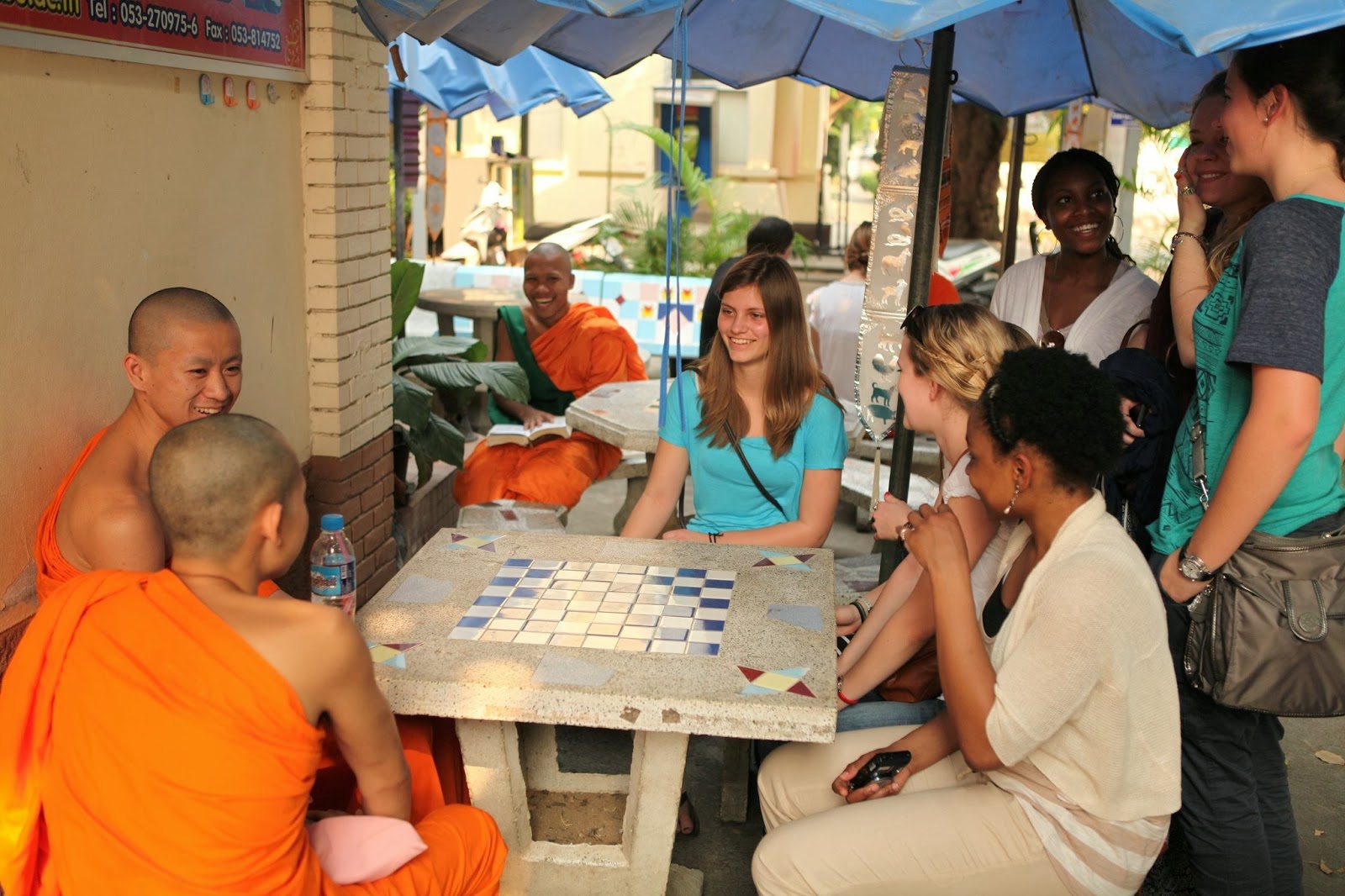
Friendship Tours World Travel (FTWT) educational travel programs  foster awareness of the necessity for alternatives to violence. Through socially-conscious travel, we are able to engage students to understand the results of war and violence on communities. By being present with the local people in historical sites where massacres, bombs, or protests occurred, we get in touch with our own humanity. Understanding the dark mistakes of the past and observing the transcendent power of the human potential to recover from horror empowers us to become ethical citizens of a global community.  We see how many places have recovered, moved forward, and established hope in the future. Hope in humanity is a wonderful thing; we invite you to join us and feel it for yourself.  


September 26, 2013

In Myanmar Outpost, a Fading Orwellian Link


KATHA, Myanmar — George Orwell created his first novel, “Burmese Days,” a scathing portrait of the imperious attitudes of the British, from this former colonial outpost on the banks of the mighty Irrawaddy River. His brutish characters swilled too much whiskey at a whites-only club, and wilted in the vaporous heat. A train that crawled through the jungle from Mandalay provided a lifeline to the outside world.


The British have long gone, but Katha, camouflaged in the book as Kyauktada, survives as isolated as ever, one of the most tantalizingly difficult places to reach in the rugged precincts of northern Myanmar, formerly Burma.
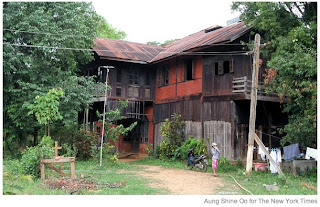
The remaining whiff of Orwell, whose five years at various stations in Burma as an officer of the Imperial Police Force ended here in 1927, is a spacious two-story wooden house with fireplaces and a once-elegant staircase. Paint peels off the walls, and dust coats the interior. The outdoor kitchen where Orwell’s servants cooked his meals lies in ruin, the roof missing and dead leaves piled on the floor. The family members of a government official squat in an annex, and hang their laundry outside the front door.
Most people in this town of 23,830 — like the British, the local authorities keep precise records — appear unfamiliar with Orwell. The junta that ruled Myanmar admired the anti-imperial spirit of “Burmese Days,” but translations in Burmese were scarce, said Nyo Ko Naing, a cartoonist and graphic designer who has joined a small group of local Orwell aficionados to encourage the authorities to restore the house and its unkempt garden, with its three acres of frangipani and flame trees.
Last month, a minister from the provincial capital came to inspect the house. Mr. Nyo Ko Naing has mounted photographs of Orwell memorabilia in his wife’s restaurant to pique interest. Among the exhibits: an old cover of “Burmese Days” with an Englishman lounging with his feet up and his dog comfortably resting on a stool next to him. A forlorn Burmese servant stands behind, waving a fan to cool his master.
“We don’t have formal word from the government yet,” Mr. Nyo Ko Naing said. “But we hope they will restore it.”
Hardy Orwell readers from abroad drift into Katha from the occasional leisure cruises that ply the Irrawaddy. The other option is a jaw-shattering six-hour road trip, from Bhamo, near the Chinese border, which means traversing 100 miles over gullies of dirt and rock at a plodding pace like the train in 1927.
Wildlife smugglers are willing to take passengers from Bhamo to Katha for $350 round trip, more expensive than most domestic air tickets. The price is steep because human passengers take the place of the smugglers’ usual fare: fat Burmese cobras packed in wooden crates for transport to China.
Convoys of motorbikes weighed down with illicit loads of teakwood heading for buyers in China are the only passing traffic.
The novel is full of references to what Orwell called “wood extraction,” but the forests that lured the British to Burma have been decimated by rampant illegal logging. A landscape of low-lying scrub and plantings of new rubber trees testifies to that. The sublime wild orchids of Orwell’s period — nestled in tree trunks, hanging from eaves — have vanished.
Some things in Katha remain intact. Orwell wrote of a dawn market brimming with “pomelos hanging on strings like green moons,” “brittle dried fish tied in bundles,” “ducks split open and cured like hams,” and “chickens cheeping in wicker cages.”
That variety still exists. On a recent morning, there were globes of mauve eggplant; baskets of pale green tamarind leaves; five kinds of brown mushrooms; slivers of yellow bamboo shoots; tiny crimson chilies; pyramids of pink lychees; and seven crates of different size brown, tawny and white eggs. Hawkers of heart-shaped green betel leaves did a brisk business.
Missing delicacies from Orwell’s era were the “heliotrope-colored prawns the size of lobsters.”
“We get them only occasionally,” said Ma Nge, a fish seller, blood oozing through her fingers from the catfish she was dicing on a wooden board. Flies clambered over the rows of fish laid out on her counter, as her husband, Ye Myint, swatted them away with a bedraggled T-shirt.
The snobbery and ignorance of the British overseers in Burma are exemplified by Orwell’s youngest creation, a 22-year-old naïf named Elizabeth Lackersteen who arrives here with her blond hair bobbed into an Eton crop, the mode of the late 1920s, and wearing fashionable tortoiseshell glasses. She comes in search of a husband.
Flory, a British timber merchant with a birthmark down one side of his face, the only character who shows empathy with the Burmese and who despises the boozers and bores of the British Club, falls for her.
He tries to interest her in local culture, taking her to a pwe, a Burmese play performed by gaslight outdoors on the street. She recoils at the “smelly natives,” calls most things “beastly” and prefers to laze in a drawing room perfumed by “chintz and dying flowers.”
Elizabeth’s favorite haunt is the British Club, where the men wear khaki shorts and topee hats and berate the Burmese servants for running low on ice for their tumblers of whiskey and gin. The club, a modest tin-roofed building, still stands, a short walk from Orwell’s house. En route, the tennis court from the novel has been modernized with a hard surface, and Ko Toe, 39, a professional coach, teaches classes in the mornings and evenings.
Remarkably, an original official diary dated 1874 to 1949 with almost daily entries in spidery handwriting in Burmese script tells much of what happened from the time the British came until after they left at independence in 1948.
The pages are curled from age and heat, the ink faded. But entries about salaries, costs of transportation, and George V ascending to the British throne in May 1910 are still legible.
In the novel, Elizabeth spurns Flory, who, overcome by desolation and rage, shoots himself. In turn, she is spurned by Lieutenant Verrall, a rude — even by British Club standards — polo-playing young army officer. At the end of the novel, the villain, U Po Kyin, an exceptionally rotund magistrate, moves to another district for a plum job.
“The bad guys win,” said Mr. Nyo Ko Naing, who has read the novel five times, searching for authenticity about old Katha. “I hate the judge. All the characters of the Myanmar military regime share the same character as the judge. I like Flory. He has a good heart.”
By JANE PERLEZ


September 23, 2013

Do you know what happened to the girl in this iconic Pulitzer prize winning photo from the Vietnam War?


8 June 1972, a plane bombed the village of Trang Bang, near Saigon (now Ho Chi Minh City) in South Vietnam after the South Vietnamese pilot mistook a group of civilians leaving the temple for enemy troops.
The bombs contained napalm, a highly flammable fuel, which killed and badly burned the people on the ground.
The iconic black-and-white image taken of children fleeing the scene won the Pulitzer Prize and was chosen as the World Press Photo of the Year in 1972.
It communicated the horrors of the Vietnam War in a way words never could, helping to end one of the most divisive wars in American history and later becoming a symbol of the cruelty of all wars for children and civilian victims.
In the centre of the photo was a nine year old girl, who ran naked down the highway after stripping off her burning clothes.
Kim Phuc Phan Thi was with her family at the pagoda attending a religious celebration when the plane struck and lost several relatives in the attack. The children running with her were her own brothers and sisters.
I had the privilege of hearing Kim speak at a meeting in New Zealand a few years ago and the 40th anniversary of the bombing was commemorated last year.
She said, looking back, that three miracles happened on that dreadful day.
The first was that, despite suffering extensive third degree burns to her left arm, back and side, the soles of her feet were not burnt and she could run.
The second was that after she collapsed and lost consciousness the photographer, Nick Ut, took her to Barsky Hospital in Saigon.
The third was that her own mother found her there later that day whilst searching for her children.
Kim remained hospitalized for 14 months, and underwent 17 surgical procedures, until she recovered from the burns.
Grateful for the care she had received she later decided to study medicine but struggled to come to terms with her deep physical and psychological scars.
‘My heart was exactly like a black coffee cup,’ she said. ‘I wished I died in that attack with my cousin. I wish I died at that time so I won’t suffer like that anymore … it was so hard for me to carry all that burden with that hatred, with that anger and bitterness.’
But it was as a second year medical student in Saigon that she discovered a New Testament in the university library, committed her life to following Jesus Christ, and realised that God had a plan for her life.
Kim never finished medical school as the communist government of Vietnam realised the value of the ‘napalm girl’ value as a propaganda symbol.
She believed that no man could ever love her with her disfigurement but later studied in Cuba where she met Bui Huy Toan, another Vietnamese student whom she married in 1992.
Kim and Toan went on their honeymoon in Moscow. During a refuelling stop in Gander, Newfoundland, they left the plane and asked for political asylum in Canada, which was granted.
In 1994, UNESCO designated her a Goodwill Ambassador for Peace.
In 1997 she established the first Kim Phuc Foundation in the US, with the aim of providing medical and psychological assistance to child victims of war. Later, other foundations were set up, with the same name, under an umbrella organization, Kim Foundation International.
Her biography, The Girl in the Picture, written by Denise Chong was published in 1999.
In 2004, Kim spoke at the University of Connecticut about her life and experience, learning how to be ‘strong in the face of pain’ and how compassion and love helped her heal.
On 28 December 2009, National Public Radio broadcast her spoken essay, ‘The Long Road to Forgiveness’.
Kim Phuc, now 50, lives near Toronto, Canada, with her husband and two children, Thomas and Stephen.
She has dedicated her life to promoting peace and providing medical and psychological support to help children who are victims of war in Uganda, East Timor, Romania, Tajikistan, Kenya, Ghana and Afghanistan.
Forgiveness made me free from hatred. I still have many scars on my body and severe pain most days but my heart is cleansed. Napalm is very powerful, but faith, forgiveness, and love are much more powerful. We would not have war at all if everyone could learn how to live with true love, hope, and forgiveness. If that little girl in the picture can do it, ask yourself: Can you?’ (Kim Phuc, 2008)
I know that my redeemer lives, and that in the end he will stand on the earth.
And after my skin has been destroyed, yet in my flesh I will see God;
I myself will see him with my own eyes—I, and not another.
How my heart yearns within me! (Job 19:25-27)


Written by Dr Peter Saunders, 30 Aug 2013