Showing posts with label Educational travel programs. Show all posts

August 18, 2014

Navigating Nicaragua: A Lesson In Getting Lost

A motorcyclist drives past a mural of revolutionary heroes in Managua, Nicaragua. Most streets in the country don't have names. People give directions by using reference points, mostly Lake Managua, when in the capital. Carrie Kahn/NPR

August 16, 2014
One of the most popular songs by the Irish band U2 is about a place where the streets have no names. That place could be Nicaragua, the small Central American nation where I just got back from a reporting trip.
While major boulevards and highways do have names in Nicaragua, and some buildings even have numbers, no one uses them. So if you are trying to get around or find an office building, let's say to interview someone, then you're in trouble.
The way to navigate Nicaragua, I quickly learned, is by reference points. When in the capital, most involve the lago, Lake Managua. Two blocks to the lake, then go three blocks south and one down. Lost? I was, constantly.
But I had help from my Nicaraguan producer, Dorisell Blanco, who thankfully also did all the driving. Her address: Start from the place where all the journalists live, head south to the entrance, go two blocks down, one to the south, two more down and then almost to the corner to the green wall.
That address is what's written on all the bills that come to her house and in the phone book. "God help her the day they paint that wall a different color than green ... everyone is going to get lost," Blanco says.
But people don't seem to get lost, and the mail and pizzas get delivered. The firemen also get to the fires, insists fire chief Francisco Reyes.
"We're all used to it ... so it's hard just for the out-of-towners," Reyes says. Though he admits he has received some odd directions. Once a dispatcher gave him the reference point, and then said from there go three blocks down and three blocks up. He was back where he started.
If that isn't mind-numbing enough, there are two more complicating factors when getting directions: the vara and what I call the donde fue. Vara is an old Spanish measurement that turns out, depending where you are in the world, is about a yard. People will tell you often to go two varas south and then one vara north. It's used interchangeably with a block, but a much shorter distance.
The donde fue direction, now, that's the toughest. That's a reference for something that used to be there. For example, the church that fell in the 1972 earthquake or a supermarket long closed, but everyone used to go to.
But here's the best part of the system: It works. That's because everyone helps out. Once you get close to your reference point, you start asking for directions. Everyone we ever asked was very willing to help. The direction discussion usually turned into a five-minute ordeal, not efficient at all, but always, always, extremely friendly.

August 13, 2014

Friendship Tours' student brings clean water to Rwanda


Clean water for all.

In January sixteen-year-old Cole Kawana joined a school trip to visit Network for Africa’s projects in Rwanda. But before he left Los Angeles he spent months researching the everyday challenges faced by people in developing countries. One of those stumbling blocks, Cole knew, was lack of access to clean water.

Cole demonstrates his water filters to Aspire staff and participants.
Cole found a potential solution: a water filter that could serve 100 people for up to five years, removing 99.9% of harmful bacteria. It uses no chemicals, and relies on gravity to force the unclean water through the filter. Each filter costs £30/$50, which works out as 50 cents for five years’ worth of clean water for each person.

Cole asked Network for Africa if he could run a pilot project with our partner Aspire in Kigali. Cole then raised enough money to buy twelve filters, and warned us to have dirty water and five-gallon buckets at the ready. Once Cole was in Rwanda his school group spent time at Aspire, watching the Aspire team as they taught local women about health, hygiene, nutrition, First Aid, and about their legal rights. He also saw women being trained in hairdressing and cookery.

When Cole’s moment came, dozens of people gathered around to watch as he demonstrated how to use the filters. It took only 20 minutes to turn dirty, cloudy water into clear water suitable for drinking. Cole then trained several members of the Aspire staff to use the filters, and they have since taken them to schools in the area. The filters were so popular that when he returned to California, Cole raised money for a further twelve filters, which were taken to Kigali by representatives of Steven Spielberg’s Shoah Foundation.

Cole holds a jar of dirty water next to a jar of purified water.
Cole is now setting up his own non-profit, Clean Water Ambassadors. He intends to produce an online demonstration, with Skype tuition sessions on the proper maintenance of the filters. His ethos is not to spend money on postage or air travel: he will rely on people traveling to parts of the world where the water filters are needed, and connecting with local non-profits they already know.   Since his visit to Aspire earlier this year, Cole’s filters are now being used in Tanzania, Uganda, Belize and Fiji. Network for Africa is proud to have played a part in the birth of an smart solution to an age-old problem.


August 7, 2014

Nixon reframes Watergate scandal in rereleased 1983 interviews

President Nixon's farewell on Aug. 9, 1974, as he boards a helicopter at the White House. (Associated Press)


On the eve of Richard Nixon's resignation 40 years ago, he could hear protesters chanting outside the White House as he retired to the Lincoln Sitting Room to make calls.
The distant shouting reminded him of the height of the Vietnam War protests. "Except this time," he recalled during the more than 30 hours of interviews that he did with his former aide Frank Gannon in 1983, "the chant was 'Jail the Chief! Jail the Chief!'"

But the 37th president was unmoved. "It didn't bother me," he said, smiling in his conversation with Gannon nearly a decade later. "You know, after all, I'd been heckled by experts."
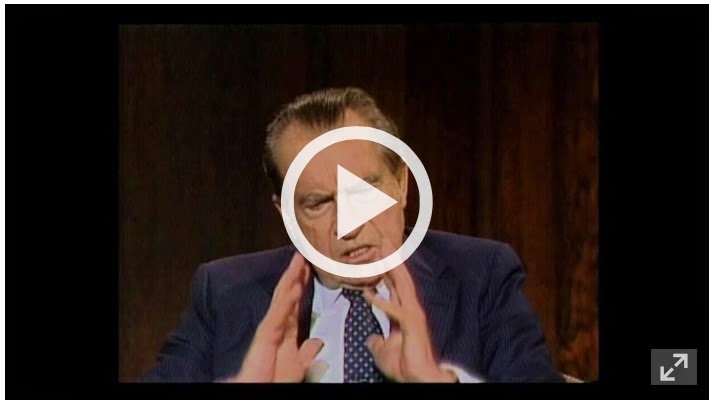
 Click here to view video

It was that brazen side of Nixon — impervious to criticism and casting himself as a victim even as he stepped down — that infuriated millions of Americans during what became a moment of national shame. Nixon's deception and abuse of executive power stunned the nation.
The Gannon-Nixon tapes, part of Nixon's post-presidency attempt to rehabilitate his reputation, are being rereleased this week for a new generation by the Richard Nixon Presidential Library & Museum and the Richard Nixon Foundation to mark the 40th anniversary of his resignation and the presidential scandal known as Watergate.
The clips in the series are appearing day by day through Saturday on YouTube, Facebook and Twitter. Sitting down with his longtime aide in a nonconfrontational setting — markedly different from the contentious Frost/Nixon interviews of 1977 — the former president frames one of the most famous political scandals in his own words.
The tapes are being billed by the library as revealing the former president's more emotional, candid and reflective side. They are at varying times maudlin, craven, emotional; even in 1983, Nixon appears to see himself as a man wronged, saying that he had resisted resigning because it would be an "admission of guilt" that would have set a bad example for future presidents.
While they do not provide new revelations about the Watergate affair, which began as a 1972 break-in at the Democratic National Committee headquarters in Washington, they do provide intimate details of the Nixon family's last hours at the White House and a powerful leader's gradual submission to the politically inevitable.
The damning revelations of his involvement in the Watergate coverup by then were rolling into public view. He had lost the three votes he was counting on in the House Judiciary Committee to protect him from impeachment. Key supporters were abandoning him. And he could not bear the spectacle of going on trial before the Senate as "a crippled, half-time president."
But in Nixon's mind, he was still a victim, the tapes indicate. Even in those final White House days, he was still defiant about what had "happened" to him, basking in the adulation of loyal aides, and nurturing his lingering hesitation with a note left in his bedroom by his daughter Julie, who begged him to "go through the fire," noting that millions still supported him.

"I'm a fighter; I just didn't want to quit," Nixon said. "Also, I thought it would be an admission of guilt, which of course it was," he added. "And ... it would set a terribly bad precedent for the future."
But the damning tape of the "smoking gun" conversation, recorded in the Oval Office only a few days after the break-in and firmly establishing his knowledge of the burglary and coverup, "was the final blow, the final nail in the coffin. Although you didn't need another nail if you were already in the coffin, which we were."
Nixon recalled calling his family together and bringing with him a transcript of the tape to convince them he had to resign.
After his televised address to the nation on the night of Aug. 8, 1974, Nixon walked back to the residence with top advisor Henry Kissinger. "He said, 'Mr. President, history is going to record that you were a great president."
"I thought it would be an admission of guilt, which of course it was,” former President Nixon said in a 1983 interview of his reluctance to resign. (Raiford Communications)

Nixon's version of events is once again stirring debate among historians, some of whom say it represents a misleading view of a crucial chapter in American history. Watergate historian Stanley Kutler described the videos as a desperate attempt to "rewrite history" and said he had urged the library to create a more informative exhibit. "This was Nixon carefully programmed.... This was Nixon in the middle of his last campaign."
Nixon asserted, for example, that he had already made up his mind to resign before the incriminating "smoking gun" tape was revealed.
"That's not true," said Kutler, a professor emeritus of history at the University of Wisconsin-Madison. "He was still trying that day to stay in office — and finally one Republican congressman after another told him he had to quit."
In Yorba Linda on Tuesday, there was no rush of visitors to see the excerpts on display, selected from the interviews and played in a loop in a darkened theater.
For much of the day, the theater was nearly empty as a few older couples and the occasional family trickled in to watch them. Many visitors seemed oblivious to the anniversary and said they did not know that the tapes were new. Some said they were too young to remember Nixon's resignation; others said they had become more fond of him over the years.
For 81-year-old Nancy Jerdee of Chandler, Ariz., there was not much new, but it brought back her sadness from that day. "I lived through all of that," she said, describing Nixon as a great president. "It was such a stupid thing to have to resign over.... Presidents have done a lot worse than that."
Nixon recalled that he did not sleep much the night before his last day in the White House. When he awoke, he realized that the battery had worn out on his watch — it had stopped at 4 p.m. on his last day as president. "By that time," he said, "I was worn out too."
Nixon recalled how he closed his eyes as he stepped aboard the helicopter for the last time. "I heard Mrs. Nixon speaking to no one in particular, but to everyone," he said. "It's so sad," he remembered her saying. "It's so sad."

Copyright © 2014, Los Angeles Times

August 1, 2014

Don’t Know Much About History

The architects of our foreign-policy disasters would prefer we simply forget the past.


Clockwise from top left: Elliott Abrams, Henry Kissinger, Bill Kristol, Dick Cheney
(AP Photo/Manuel Balce Ceneta; Reuteres/Pascal Lauener; Gage Skidmore CC2.0;
AP Photo/Richard Drew)

I recently happened to be in the audience for a discussion on the legacy of World War I, held at the Thompson/Reuters headquarters in New York City, when Henry Kissinger made an amazing observation: of the five major wars that the United States has fought since World War II, all were entered on behalf of “idealistic principles.” No less surprising to me was the fact that nobody else in the crowded room of media and policy bigwigs appeared to find anything odd about that statement. Given what we now know about the lies, deception and corruption that preceded the most catastrophic of these wars—Vietnam and the second Iraq War—to call them “idealistic” is to purposely evade history at best, or (more accurately) to rewrite it purely on the basis of ideology rather than evidence.
Now Kissinger, at 91, may be pretty old and famously amoral, but he is not senile and has never been stupid. He offered his blinkered version of recent events before a room full of knowledgeable people because he figured nobody really cared one way or another. After all, it was “history”—which, in contemporary American political culture, is another word for “irrelevant.” And it is this contempt for history, as the cliché correctly advises, that condemns our nation to continually repeat it. The circumstances may differ, but the pathology remains unchanged.
Neocons are surpremely aware of this tendency and exploit it to the fullest. In fact, most of their careers would be impossible without it. Would Elliott Abrams be able to mouth off as a respected Senior Fellow for Middle Eastern Studies at the Council on Foreign Relations, attacking Barack Obama in a recent Politico piece as “The Man Who Broke the Middle East,” if his patrons took the time to consider that Abrams both enabled and ran political interference for what the Guatemalan Supreme Court of Justice has deemed a genocidal dictatorship? (Abrams also got himself disbarred in the District of Columbia for his lies to Congress about these and other crimes in which he participated while serving in the Reagan administration, both before and after the Iran/Contra affair.) Should that stretch American memory muscles beyond their breaking point, how about the fact that this criminal, while serving on the National Security Council during Bush II, himself helped to “break” the Middle East by undermining the 2006 Palestinian elections, which helped lead to the creation of a Hamas-run rump state in Gaza in the first place? And yet he somehow gets away with the crazy claim that “the Middle East that Obama inherited in 2009 was largely at peace” in order to blame its alleged collapse on the current president. (Politico is, conveniently, the ground zero of American political ahistoricity: virtually everything it publishes occurred during the previous twenty-four hours and will cease to matter within the next forty-eight.)
Numerous observers have expressed incredulity over the eagerness of so many media mavens to allow the discredited armchair warriors of the 2003 US invasion of Iraq to dominate discussion of the current crisis in that country—a crisis whose foundations they helped put in place. In a saner world, each one would, at a minimum, be required to answer the following question: “Given your record the last time this issue arose, why in the world should we listen to anything you have to say today?” But as the respective rehabilitations of Henry Kissinger and Elliott Abrams demonstrate, being a known liar and an arguable (Kissinger) or unarguable (Abrams) enabler of genocide is no barrier to career advancement in the American establishment, thanks to the collective amnesia of its most elite institutions, especially its elite media.
Sometimes they lie outright. Here are Dick and Liz Cheney writing in The Weekly Standardregarding the Iraq invasion: “It is undisputed, and has been confirmed repeatedly in Iraqi government documents captured after the invasion, that Saddam had deep, longstanding, far-reaching relationships with terrorist organizations, including al Qaeda and its affiliates.”
Undisputed? Really? How about, just for starters, the 9/11 Commission, before which Cheney testified. Its final report, as Warren Bass noted in The Wall Street Journal, states that the commission has “seen no evidence [of] a collaborative operational relationship. Nor have we seen evidence indicating that Iraq cooperated with al Qaeda in developing or carrying out any attacks against the United States.”
William Kristol, perhaps the wrongest pundit in all of American history—and hence also the most sought-after by media institutions like The Washington PostThe New York Times,Time, ABC News, etc.—demonstrates a coy agnosticism when it comes to the choice between outright fabrication and contempt for the historical record. He doesn’t mind pretending, as he did on ABC’s This Week With George Stephanopoulos, that the current crisis was caused by what he termed “our ridiculous and total withdrawal from Iraq in 2011,” when in fact that withdrawal had been decided on in the 2008 Status of Forces Agreement negotiated with the Iraqi government by George W. Bush. But Kristol is just as comfortable asserting in The Weekly Standard (in an article written with Frederick Kagan), “Now is not the time to re-litigate either the decision to invade Iraq in 2003 or the decision to withdraw from it in 2011.” This is perhaps the only path available to someone with the chutzpah to insist, back in April 2003, that it was merely a “kind of pop sociology in America that, you know, somehow the Shia can’t get along with the Sunni,” when that same person today is calling for yet another attack on the country to deal with the Sunni/Shiite massacres inspired by the earlier one. But as Kristol, Cheney, Abrams and Kissinger demonstrate over and over, success within our political punditocracy means never having to say you’re sorry.


July 30, 2014

Laos, US Legacy, and Unexploded Ordnance


For decades, Laos’ economic development and relationship with the United States has been strained by unexploded ordnance (UXO), a legacy of the Vietnam War.
Roughly 30 percent of the two million tons of bombs that the United States dropped in Laos during the Vietnam War failed to detonate on impact. To date, only about one percent of affected land has been cleared and over twenty-thousand people have been killed or injured by UXO since 1975.
However, in January 2014, Congress allocated $12 million in funding towards UXO assistance programs in Laos as part of the omnibus spending bill, four times the average annual UXO budget from 1995-2013. This creates an opportunity for the United States to address a key flashpoint in U.S.-Lao relations while making strategic development inroads with the largest single benefactor of Chinese investment in the region.
Since the end of the bombing in 1975, the United States has provided $74 million in UXO assistance in Laos, with forty-percent allocated in the last five years.
Laos receives an annual $4 billion from China in mining, hydropower, and agricultural investments.

U.S. assistance towards improving UXO clearance efficiency will focus on providing better technology and training programs, assistance for families and victims, as well as developing the capacity of national institutions to absorb this assistance.
In previous years, clearance operators reduced cluster bomb related casualties from an average of roughly 300 per year to 41 in 2013. The increase of resources, if leveraged efficiently, can bolster these efforts and set the stage for significant economic development in the country.
There is a long road ahead – or rather very little road. UXO cover half of the country, and as a result only about 53 percent of national roads and 3 percent of local roads are paved. Additionally, there is no national or transnational railway system, and roughly 40 percent of villages and 10 percent of district centers lack road access during the rainy season. Clearing land from UXOs alone add 30 to 40 cents in cost per square meter of road creation.  As a result, large segments of the population remain isolated from basic social services.
UXO has also impacted critical investments in institutional infrastructure including schools, hospitals, water supply facilities, and power plants as scarce public funds are diverted to clearance efforts. The result has been a slew of development challenges that plague Laos, including falling literacy rates (from 89 percent in 2005 to 77 percent in 2012), poor access to clean water and sanitation, and an inconsistent supply of power.
The proliferation of UXO in Laos has stunted development efforts and prevented the creation of infrastructure needed to attract and absorb foreign investment. For example, the World Bank’s 2014 Doing Business Indicators  estimates that it costs an additional $1,155 to ship a container across a border from Laos than it does to ship one from Cambodia. In addition, investors surveyed complained that even with low-wages, poor physical and institutional infrastructure, and a poorly educated workforce make the labor force uncompetitive compared to neighboring countries like Cambodia.
UXO also severely hampers Lao agricultural productivity and contributes to persistent food crises as farmers are unable to expand production onto otherwise fertile land. Although agriculture employs 76 percent of the population, it accounts for less than 1 percent of total GDP and as of 2011, only 7 percent of total land in Laos is being used for agriculture.
It is within the United States’ interest to ensure a prosperous Laos, and addressing the issue of UXOs is the first step toward this direction. Laos will ascend to the ASEAN chairmanship in 2016, and like its predecessors Brunei and Myanmar, will be well-poised to influence the agenda in the region. To this end, the UXO issue is low-hanging fruit that yields high dividends in terms of both developmental and political gains.  The United States has the chance to construct a new legacy in Laos, and for a host of reasons, it should seize the opportunity.
Image courtesy of Flickr under creative commons license.
Elena Rosenblum is a researcher for the Project on U.S. Leadership in Development at CSIS 

July 7, 2014

U.S.-Cuban Relations on Higher Ed Level Continue to Grow


Something historic happened last January at Miami-Dade College. At a community college that stands as one of the nation’s largest institutions of higher education with approximately 170,000 students spread across seven campuses, 15 foreign exchange students from Cuba arrived at the school for a semester of study.
Despite the trade embargo and the lack of formal diplomatic ties between the United States and the communist island nation, American colleges have maintained relationships with Cuban universities for the last several decades. Many send professors and students to Cuba for study or research. But this was the first time in more than 50 years that the Cuban government had permitted students to come to the United States to study.
The student exchange is just one of several examples of change by the Cuban government in recent years. The government has relaxed some of its hardline policies and restrictions on issues like foreign travel by Cubans, as well as property and small business ownership. Political observers say some of these changes are driven by a need for a greater infusion of cash into the island nation. This way, a significant number of Cubans get to travel abroad. Some of these emigrants don’t return, but most send remittances back to relatives and friends at home, a move that significantly aids Cuba’s tattered economy.
This new form of openness by the Cuban government could lead to more bridge building between colleges and universities in both countries.
International students from Cuba are already studying at American colleges in small but slowly rising numbers. According to Open Doors data supplied by the Institute of International Education, 76 students from Cuba were enrolled in U.S. universities during the 2012-13 school year, up from 57 the previous year.
“There is a great desire from higher education institutions in both countries to see an increase and broadening of U.S.-Cuba exchanges,” IIE president Allan Goodman tells Diverse by email. “There are a number of U.S. college and university pioneers that have been bringing American students to Cuba for many years, but the opportunity for true mutual exchange remains challenging.”
Continues Goodman, “Despite a host of challenges, institutions in both countries have expressed the need to expand exchange opportunities; not only for students, but also for faculty and researchers. The potential for collaboration is clear and the motivation is high, but institutions will need to continue to navigate the ever-changing infrastructure to ultimately see any results.”
Some of the barriers to making programs like this happen are both financial and political. Most Cubans can’t afford the thousands of dollars (in some cases tens of thousands of dollars) to study at an American college. Moreover, many U.S. politicians still have tough attitudes about a communist regime that’s been running the Caribbean nation for 55 years. The state of Florida, for example, has a law that forbids public colleges from using state funds for Cuban-related programs or exchanges.
Most foreign exchange students pay their own way or get scholarships to come to the U.S. to study. The students’ tuition, travel and boarding expenses were paid for by the Foundation for Human Rights in Cuba, which received a grant from a U.S. agency.
Students’ experiences
The students are a diverse mix of gender, race and age. While some of the students are teenagers, others have college degrees or law degrees, says Dr. Victor Vazquez-Hernandez, chair of the Social Sciences Department at the Miami-Dade Wolfson campus and the designated college official who oversaw the process of recommending courses for the students.
In addition to English language classes, the students, who are in the states on a six-month visa and are scheduled to return home in July, took courses in principles of business, psychology of personal effectiveness, introduction to computers and introduction to sociology. In all, they earned 12 credit hours apiece.
“The 12 credits are all transferrable,” says Vazquez-Hernandez. “They will transfer anywhere. The courses were chosen based on information we received about their needs.”
Vazquez-Hernandez says the campus and the community have embraced the students. “They’ve visited all campuses,” he notes. “They have had a chance to interact with students.”
Vazquez-Hernandez adds that the students met with a broad spectrum of the student body, including student leaders.
“One professor invited them to visit her history of Cuba class. They attended graduation on May 2. They were very taken by it. The faculty has indicated that the students have adapted well. They’ve been nothing but welcomed with open hands.”
As is typical with most international students, there have been some adjustments.
“It’s been intense for them because they have a schedule that is pretty full,” says Vazquez-Hernandez. “That took time to get used to. And the fact that they have free time — when you come from a system that is pretty regulated and no one is following you around — [that] took getting used to as well.”
Expanding exchange
The exchange program at Miami-Dade College has attracted the attention of other colleges.
Dr. Jorge Duany, director of the Cuban Research Institute at Florida International University, says his institution had been exploring the possibility of having a similar program at FIU, hoping to bring 15 to 20 students from Cuba.
He says he was pleasantly surprised to learn about the arrival of the Cuban exchange students at Miami-Dade College.
“I was disappointed we weren’t the first,” says Duany, a professor of anthropology.
He says FIU still plans to have an exchange program with a Cuban college. He says they would like to focus on specific areas like business administration, computer programming, English, hospitality and tourism management. Those latter areas, Duany says, are critical for the Cuban economy. He says these kinds of programs can be vital in erasing decades of enmity between the countries.
According to Duany, FIU is targeting next summer for the program, but admits pulling it off is complicated. He says university officials are trying to coordinate interdisciplinary faculty. The university has also identified private partners who would work with them and help fund the program since state law won’t permit the university to pay for it.
Duany says the academy is a great environment for bringing people of both nations together.
“The two countries don’t have diplomatic relations,” he notes. “So it is important to have this people-to-people contact. The university is probably the best place to have this happen.”
Tomas Bilbao, executive director of the Cuba Study Group, a nonprofit organization in Washington, D.C., that has argued that the embargo is ineffective and counterproductive to U.S. interests, says the larger challenge moving forward will be how to expand programs like that at Miami-Dade College so it reaches a wider range of Cuban society and “not just singling out people because of their ideological beliefs.”
“It’s a great start,” he says. “The more people we have, the more diversity of opinion, race, geography and gender, the better. We can’t simply rely on one organization and one community college.”
Bilbao adds that, while he understands the natural affinity for Florida, he would like to see more exchange students from Cuba spread throughout the country.
Jaime Suchlicki, director of the Institute for Cuban and Cuban-American Studies and a professor of history at the University of Miami, agrees that, for the program to have significant impact, it has to get bigger. But he says he’s not holding his breath.
“The Cuban government is not going to allow it on a large scale,” says Suchlicki, who left Cuba as a 19-year-old college student in 1960 and has not been back. “They are very concerned about penetrating influence. They are not going to allow it to happen on a large scale. There’s a reason why they’ve been in power for (55) years.”

by Lekan Oguntoyinbo

July 6, 2014

On Being Gay, And Socialist, In Cuba Today

by JASMINE GARSD
June 26, 2014 3:46 PM ET


i
Isbel Diaz Torres is an LGBT activist in Cuba. He sees his fight for equality as an extension of Cuba's socialist revolution.
David Gilkey/NPR


It was very late at night the last time Isbel Diaz Torres and his boyfriend were stopped by Cuban police.
"They asked for our IDs, which is a rare procedure," Diaz recalls.
The policeman then dropped the men's IDs on the floor.
" 'That's very funny for you, a very funny thing to do,' " Diaz, an LGBT activist, said to the policeman. " 'Because you want to humiliate me, that's right?' "
He took the policeman's information down and went to the station to report him.
"It wouldn't change anything, but it is my civic duty," the 38-year-old Diaz says.
There is a long history of homophobia on the island. "Sons of the bourgeois, they go around with their little pants that are too tight. ... They want to do their girlie scenes out in the open," is how former Cuban President Fidel Castro attacked the young opposition in a 1963 speech at the steps of the University of Havana.
During that time, gay people, along with other "counter-revolutionaries," were sent to forced labor camps.
Cuba's attitudes toward sexual orientation have changed a lot since then: There's been a recognition of LGBT rights, promoted in no small part by Castro's own niece, Mariela Castro. Fidel Castro himself has recently criticized the machismo culture of Cuba and urged for the acceptance of homosexuality.
Activists like Diaz acknowledge the importance of these changes, but say it's hardly enough. Diaz says it's happening mainly in Havana, the capital, where there are gay-friendly bars, for instance.
But Diaz says he wants to be more than just able to have a good time out in the open.
"We can socialize. We can be together and have fun together," he says. "But you cannot build political groups in those bars. You wouldn't be allowed."
Ultimately, Diaz wants concrete laws protecting the Cuban LGBT community.
"We recently have changes in the Communist Party where they included a clause claiming respect for people with different sexual orientation," he says. "But that is not enough, because most of the people here in Cuba are not part of the Communist Party. We need real laws."

For example, if his boyfriend is in the hospital, Diaz wouldn't be able to visit him.
"Entrance to the hospital is limited to the familia, the close relatives," he says. "I wouldn't be allowed in ... even if we lived together for 13 years."
Attitudes toward the Cuban regime have traditionally been very polarized — split neatly between a right-leaning opposition and leftist supporters. But a new generation is changing that. Diaz represents a class of young socialists that is also highly critical of the government.
Diaz is a member of the group Observatorio Critico, or Critical Observatory, a network of collectives seeking a place in the Cuban political landscape. They have a blog, which they publish via email since Internet access is limited in Cuba. The activists aren't really able to see the final product, or the comments, but still like to have an online voice.
Staking a claim in cyberspace is difficult for these groups. Finding an actual physical meeting place is an even bigger challenge. Often, they meet in the park.
In fact, that's where we meet with Diaz; he says he doesn't feel safe bringing us to his house. But meeting in public to discuss discontent has its drawbacks — namely, unwelcome guests from the government listening in.
The Cuba Diaz envisions is one where everyone can be involved in the decision-making.
"We also are fighting for a country where all the differences can be shared," he says. "Racial differences or cultural differences or sexual differences can be, can live together, can find a space for themselves here."
It sounds utopian, but Diaz is OK with aiming high.
"Maybe centuries ago it was funny to talk about the eradication of slavery, and it happened," Diaz says. "I think utopia, that's what moves a lot of people and thinkers and people of action during the history of humankind. We don't have to be afraid of that."