August 29, 2012

Cambodian Landmine Museum - Partner Highlight

 Laguna Blanca School 2012 Friendship Tours travelers with Aki Ra.
Our Friendship Tours students learn and fund-raise on behalf of the Cambodian Landmine Museum. CLM is an educational center for tourists to learn more about the consequences of landmines and Aki Ra’s noble work. Administrated by the incredible husband and wife team, Bill and Jill Morse, CLM serves as a global community resource. In addition to providing an interactive museum, fascinating displays, and informative guided lectures, the museum also boasts a gorgeous gift shop filled with artisan objects made to benefit landmine victims. Whether it’s a compelling T-shirts, woven textiles, books, music or jewelry made from re-purposed ordnance, the products support the self-sustainability of landmine victims-turned entrepreneurs. Jill Morse administers an exceptional onsite orphanage and school that services disabled and economically disadvantaged children. The learners range in age, though all are motivated to become proficient in all subjects in preparation for college. 


Our Friendship Tours students are lucky to engage in a conversational English and digital pen-pal communications with the students of the Cambodian Landmine Museum. 

Contact Us for information about how to connect your classroom in a pen-pal exchange.   (info@friendshiptoursworld.com)

August 28, 2012

NEWS RELEASE - AKI RA WINS MANHAE GRAND PRIZE FOR PEACE

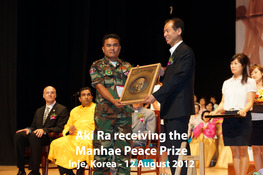
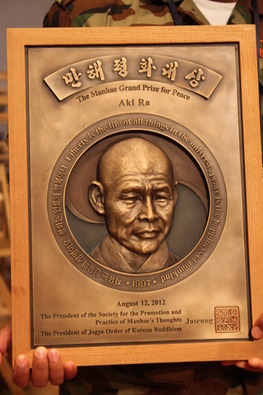
On August 12, 2012 Aki Ra was honored by the Manhae Foundation, in Inje, Republic of Korea, with the 2012 Manhae Foundation Grand Prize for Peace.  It was awarded to him for his continuing efforts to free Cambodia from the ravages of nearly 35 years of warfare.  The legacy of this terrible period has been the landmine, a perfect soldier, that continues to fight and destroy lives for decades.

Akira receiving Manhae Peace Prize copyAki Ra stated that he was humbled and honored by the recognition of the Manhae Foundation.  He also wants all to know that he is only one of many working to make Cambodia a safer place for all.  Organizations from across the globe have been working in Cambodia for decades to clear these terrible weapons, and while he is overjoyed that people have recognized his efforts, he accepts this award on behalf of everyone, around the globe who is contributing to end the scourge of landmines and other remnants of war. www.landmine-relief-fund.com

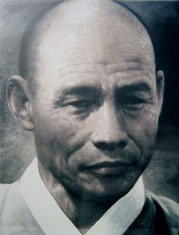
Manhae 2 The Society for the Promotion and Practice of Manhae's Thoughts established   the Manhae Prize (Manhae Daesang) in memory of, and for the dissemination of, the high thinking and noble mind of Reverend Manhae(1879-1944).
 
Manhae was born in southern Chungcheong province South Korea. Prior to being ordained as a Buddhist monk, he was involved in resistance to Japanese influence in the country, which culminated in the Japanese occupation from 1905-1945. The same year the occupation began, 1905, Manhae was ordained as a Buddhist monk at Baekdamsa temple on Mt. Seorak.

As a social writer, Manhae called for the reform of Korean Buddhism. Manhae's poetry dealt with both nationalism and love, one of his more political collections was Nimui Chimmuk(님의 침묵), published in 1926. These works revolve around the ideas of equality and freedom, and helped inspire the tendencies toward passive resistance and non-violence in Korean independence movement.

His poems mainly concern his philosophical meditation on nature and the mystery of human experience.

Aki Ra's comments on receiving the Manhae Grand Prize for Peace:

Dear Manhae Foundation,

IMG_6254I would like to thank you for this very great honor. The work we do in Cambodia to make our country safe often goes unrecognized and I am grateful whenever the world takes notice of the difficulties we, and other countries, contend with in dealing with the aftermath of wars that ended many years ago.

The many people who were forced to fight in the 35 years of war in Cambodia had no choice. The war made them become what they became. We can never forget what happened here, but we need to move forward, and make a better country for our children.

Cambodia has received a lot of help from many countries around the world. I became involved in clearing landmines because I want to make my country safe for my people. We are assisted by people from all over the world, and I am grateful for the help.

While my country is getting better, many people live without clean water, electricity, health care and most of all education. As well as clearing landmines with our landmine NGO, I started the Landmine Museum Relief Center to care for children from small villages who were landmine victims, were born with a handicap, were orphaned or come from families too poor to care for them. Our Relief Center houses them, cares for them and provides them with a university or trade school scholarship. And it is done without making them a spectacle. They live in their own village where they thrive. The Relief Center is not a rehabilitation sight. That is provided by the government and international NGOs and we take advantage of everything that is available. Our Center gives the children a solid home and a future. Tourists can support them by visiting the museum, but their home is closed to visitors.

Our country has many landmines left. It also has many unexploded bombs and artillery shells left over from the war. I will continue to dedicate my life to making my country safe for my people.

Again, thank you for the recognition and this great honor. It is with this kind of help that my country and many others can be free from landmines in our lifetime.

YOU CAN SUPPORT AKI RA AND HIS WORK BY DONATING TO HELP CLEAR A MINE FIELD. 

DONATE AT:
CLICK ON THE DONATE BUTTON

August 22, 2012

Phyllis Diller 1917-2012


Comedian Phyllis Diller performs during the Bob Hope show for American troops at Can Ranh Bay, South Vietnam, on Jan. 6, 1967. (Associated Press)
Today we honor Phyllis Diller, 1917-2012, outrageous comedienne who pioneered a signature style of comedy, and entertained the U.S. troops with Bob Hope in Vietnam, 1966. The Los Angeles Times offers an excellent tribute to her life and contributions to comedy: http://www.latimes.com/news/obituaries/la-me-phyllis-diller-20120821,0,4800295.story

Poking fun and laughing not at--but with—herself, Diller employed a self-deprecating style that endeared her to generations of fans and colleagues.

From the Stars and Stripes, http://www.stripes.com/news/us/hope-praises-warmth-of-u-s-troops-1.186380 , the official military publication of the Vietnam War, we get a glimpse into Diller’s generous holiday spirit. Reporting on Bob Hope and Phyllis Diller’s 1966 Christmas comedy appearance in Cam Ran Bay, South Vietnam, S&S writes:
Hope, always well received on his annual Christmas tours to entertain troops overseas, said he found soldiers in Vietnam even "warmer and more affectionate," than usual.
"Of course," he quipped, "I have Phyllis Diller, who is scaring both sides."
Comedienne Diller told reporters that part of her charm is due "to the fact that I know absolutely nothing."

Perhaps not coincidentally, Bob Hope and Phyllis Diller’s comedic visit to Vietnam was followed in 1968 by the release of an anti-war comedy film just two years later.   The Private Navy of Sgt. O'Farrell gives us Hope as the Navy General engaged in a WWII fight over a cargo shipment of beer. Hoping to boost morale of his troops, he fights also to secure a group of nurses for his soldiers – all of whom are men, except the zany Phyllis Diller. Though the film was not enthusiastically received by critics of the time, the anti-war message is undeniable. Taken in context, the movie underscores the talent that Ms. Diller employed to both support our troops, and parody the pointlessness of war.

“Think of me as a sex symbol for the men who don’t give a damn.” Phyllis once joked.

Oh Phyllis. You are laughter medicine for those of us who do.   

August 10, 2012

What is peace tourism?


What’s the difference between war tourism and peace tourism? Recent tourist attractions in Cambodia have addressed this question. It’s not that Cambodia is any stranger to grim tourist sights. Phnom Penh’s two most famous attractions, Tuol Sleng Genocide Museum and the Killing Fields, are relics of the Khmer Rouge’s bloody reign that killed over 2 million of its own citizens in the name of a communist utopia. Today, tourists and locals alike come in flocks to witness the horrifying setting of some of the greatest human rights abuses in the last half-century. But now the Cambodia is trying two add a few new dark destinations to its must-see sight map. Specifically, Pol Pot’s grave and toilet seat as well as the house of the Khmer Rouge commander, affectionately known as “the Butcher.”

Pol Pot's Grave


So what’s the difference between visiting the Killing Fields and say the Butcher’s last abode? Why, the quality of information provided. While Tuol Sleng and the Killing Fields are flushed with placards giving information about the conditions under the Khmer Rouge and are designed to educate people about such horrific happenings, these new sights have no information besides a “sign that says ‘please help to preserve this historical site.’” The big question: is it okay to profit from Pol Pot and his Khmer Rouge’s atrocities? And moreover, how can we distinguish between profiteering and education?

In order to answer these, let’s look back at our first question: what’s the difference between war tourism and peace tourism? The intention with which you approach your travel experience is what will decide. We can use the example of Pol Pot’s grave versus the Tuol Sleng Genocide Memorial. The Tuol Sleng Memorial is designed to educate and produce a reaction; that is, to make sure we learn from these past atrocities so that we as human beings will not continue to make them. That is peace tourism: learning the consequences of war so that we can appreciate and uphold the necessity of peace.  Pol Pot’s grave with its lack of information about the man it contains does not do this. It is a form of war tourism because it fetishizes rather than educates. It is your responsibility as a traveler, especially to a recently war torn nation, to respect this history of the place you’re a visiting. Be conscious. And before you go out, ask yourself, what is it that I am trying to learn from this? Why do I travel?


August 2, 2012

Tim O'Brien wins the Dayton Literary Peace Prize

Tim O'Brien

In a world plagued by corruption, violence and the idolatry of our golden calf—cold hard cash—it’s often hard not to get discouraged by the values of those in power and the direction the world seems to be headed. Arctic drilling, the melting of the ice caps, war in Syria, corruption at the Olympics, oppression in Myanmar, the list goes on and on and it’s often overwhelming. The knee jerk reaction to this deluge of depressing information is to simply shut it out. But instead of closing our eyes to what we don’t want to see, or writing off these problems as natural and unchangeable, let's look at people who are making a positive difference in their communities and in the world and find inspiration to start making tangible changes in our own lives.

"Never doubt that a small group of committed people can change the world. Indeed, it's the only thing that ever has" – Margaret Mead

Taking our lead from the words of Margret Mead, at Friendship Tours World Travel we’re starting our own “power to the peaceful” movement, spotlighting people around the world who aren’t afraid to stand up and say: I can make difference. To kick-start this project we recognize Tim O’Brien, Vietnam War veteran, peace activist and author. Just yesterday Tim O’Brien was recognized as the winner of the 2012 Dayton Literary Peace Prize for his body of work, including his book of short stories The Things They Carry, which humanizes the experience of US soldiers in the Vietnam War. Upon winning the award, Tim O'Brien stated, "Over what has been a long career, this award means more to me than any other by far." Congratulations Tim O'Brien your words have not fallen on deaf ears. 

To learn more about Tim O'Brien and his literary award check out the article in the Huffington Post.


Have your own inspiring story to share? Leave a comment on this post, we'd love to hear from you. 

July 19, 2012

A look at UXOs and an interview with Legacies of War


Bombed regions are highlighted in red and yellow
What's a UXO, anyway? 
Unexploded Ordinances (UXOs) is a term used to describe military armaments  (bombs,  landmines, hand grenades, bullets, etc.) that were armed and launched with the intent to kill, but which, due to design or malfunction, never detonated.  These "duds" range in all shapes and sizes and while some are clearly bombs, others are easily mistaken for rusty cans, balls or car mufflers. If touched, UXOs can explode at any moment. This makes them extremely dangerous, especially to children who might confuse a “dud” with a potential plaything. Even worse, UXOs aren’t always easy to find; some might be on top of the ground, but often they are fully or partially buried, can lurk under grass and bushes and even linger beneath bodies of water. 


Okay, but why should I care about these "duds"? 
UXOs remain in former combat zones, military testing ranges and bombing sites from recent wars. Between 1964 and 1973 the US dropped over two million tons of ordinances onto Laos, but 30% of them did not detonate! Laos alone is contaminated by 75 million “duds,” most of which are cluster bombs, residual from the Vietnam War.  Since 1964, these leftover UXOs have killed 50,000 Laotians and counting (30,000 of which were civilians)  and injured 20,000 (20,000 of these deaths and injuries occurred after the war!). That's right, UXOs continue to kill people long after wars are over and the military has packed up and left.  

So what can we do to clean up these "bombies"? 
This week Friendship Tours World had the opportunity to talk with our volunteer partner in Laos, Legacies of War, about UXOs, the Secret War, and Legacies' effort to spread awareness and clear the country from the contamination of cluster munitions. Mari Quenemoen, Program Consultant with Legacies answers our questions and gives information and advice on how you can get involved. 


Hillary Clinton at COPE in Vientiane, Laos, photo courtesy Legacies of War
What was the "Secret War"? Why was America bombing Laos in the first place?
The U.S. dropped bombs on Laos during the Vietnam War for a number of reasons. The U.S. provided support to the Royal Lao Government in a civil war against the communist-leaning Pathet Lao, and it also continuously bombed the portion of the Ho Chi Minh Trail that crosses over into Laos. Veterans of the war have also reported that pilots were instructed to release their un-used payloads over Laos rather than risk landing in Thailand with a plane full of bombs. The war was "secret" because Laos was officially a neutral country at the time, making war against it in violation of international law.  

Why do most American citizens know so little about US involvement in and bombing of Laos?
Most Americans know about the war in Vietnam because it was formally declared, and also because information about that war is readily available in our history books  and in the media. This is not the case with Laos. Even most members of Congress did not know the full extent of U.S. involvement in Laos at the time, and details of the bombings remained highly secret for decades. Recently declassified strike data finally brought to light the massive scale of the bombings. That's why Legacies strives to raise greater awareness about the history of the bombing and the ongoing problems caused by unexploded ordnance.


What makes cluster bombs so dangerous and difficult to clear?
Unlike mines, which were often set in a relatively well-defined area (hence the term "mine field"), cluster bombs were dropped over a vast territory, making their location much harder to predict. Any surface in an area that experienced bombing could be contaminated with bombs. Some bombs got buried in the soil, only to resurface decades later. Clearance teams must often survey an area multiple times before feeling confident that the area is clear. Also, as the bombs age and decay, they become more and more volatile.

What are some of the organizations Legacies works with? How have they been effective in bringing about positive change?
Legacies of War works with partner organizations providing life-saving victim assistance, mine risk education, and UXO clearance on the ground in Laos, including World Education, Mines Advisory Group (MAG), the Cooperative Orthotic and Prosthetic Enterprise (COPE) Center that Secretary Clinton visited in Vientiane, HALO, and Norwegian People's Aid. Legacies of War has also partnered with Refugee Nation, a theater troupe in L.A., to engage Lao-American communities in sharing stories about the Lao-American experience.


How can education and heightened awareness help to promote hope, healing and peace?
Our education and advocacy work has multiple goals: to increase the resources available to do UXO clearance, victim assistance, and mine risk education in Laos; to raise awareness among the U.S. public about the history of the bombings of Laos and the remaining problem of UXO; and to provide space within the Laotian-American community to heal the wounds of war. We have been struck that this issue resonates with people across the political spectrum - most people can agree that no child growing up in Laos today should have to live in fear of bombs that were dropped over 40 years ago. Legacies has successfully worked with members of Congress to support legislation to increase the resources allocated to UXO programs in Laos from $3 million in 2008 to $9 million in 2012. We have also reached out to thousands of people across the country with our traveling exhibition and our social media work. The more people know and talk about this issue, the more pressure will grow in Washington to do something about it.


What can American students do to make a difference and get involved?
College students can consider starting a Legacies of War student chapter!  Even without a chapter, students can raise awareness on campus in multiple ways: hosting a screening of a film like Bombies or Surviving the Peace, organizing a Lao meal or trip to a Lao restaurant with a presentation on UXO, organizing a petition drive, or creating an exhibit to raise awareness at a community or campus event. We would be happy to talk to student groups interested in doing more!  Also, getting involved can start small...."like" our Facebook page, follow us on Twitter, share our content, and spread the word!


How has Legacies been effective in clearing UXOs and helping the future of the Laotian people?
1) Through our education and advocacy efforts in Washington, DC, Legacies has helped raise the level of U.S. funding allocated to UXO programs in Laos. More money means more land cleared, more farmers able to safely tend to their fields, and fewer children playing on contaminated soil.

2) We have increased the visibility of this issue so the next generation will contribute to ending this legacy of war in Laos. UXO contamination is a large problem that will require a long-term solution - at current funding levels, it could take 100 years to solve. We need a significant, sustained investment over the long term to make Laos bomb-free.

3) Our outreach efforts have allowed people affected by the bombings and UXO, in Laos and in the U.S., to share their stories and continue healing the wounds of war.Most Americans know about the war in Vietnam because it was formally declared, and also because information about that war is readily available in our history books  and in the media. This is not the case with Laos. Even most members of Congress did not know the full extent of U.S. involvement in Laos at the time, and details of the bombings remained highly secret for decades. Recently declassified strike data finally brought to light the massive scale of the bombings. That's why Legacies strives to raise greater awareness about the history of the bombing and the ongoing problems caused by unexploded ordnance.


July 16, 2012

Reflections on Laos

In March a group of Friendship Tours World students traveled to Laos, where they visited COPE, an organization that provides prosthetic limbs and orthotic rehabilitation for victims of UXOs (unexploded ordinances). From 1964 to 1973 the US dropped over two million tons of cluster munitions onto Laos. The campaign was part of the CIA's "Secret War," which was intended to support the Royal Lao Government against the communist forces of the Pathet Lao and the North Vietnamese. While the US has long since packed up and gone home, 30% of the munitions dropped on the country remain unexploded, and 37% of Laos is still contaminated with these "bombies." 40 years after the war, less than 1% of the UXO's have been cleared; and while the US spent $17 million per day dropping bombs, between 1993 and 2010 it has only spent $3.1 million per year cleaning them up.

Motivated by her experience in Laos and time at COPE, Clarissa Coburn, an 11th grader at Laguna Blanca School in Santa Barbara, CA wrote a letter urging Americans to visit Laos and do their part to help heal the country from the bloody legacy of the Secret War:


Clarissa at COPE

Reflections on Laos, the Secret War and Unexploded Ordinances
Clarissa Coburn, 11th grade
Laguna Blanca School

Wars in history books are about facts and statistics:  famous people, important dates, key strategies and the long-term political and economic effects, as understood by the “winners.” But when it comes down to it, war isn’t as clean cut or simple as it is made out to be. There are no true winners when casualties are a consequence. It is really hard to remember that all of the lofty ideals and pure motives in the world cannot change the fact that people will die — innocent people who may or may not support those who are the intended target.

That’s what I learned in Laos, it’s embarrassing that I had to go all the way to South East Asia to realize something that should be completely obvious: all of those statistics--those “body counts”--were once real, living people with hopes, dreams and potential. Every statistic that  says 10,000 people died in a war, really means that 10,000 people had their lives cut short. And it’s not just those individual losses; for each of those deaths, 10,000 families lost loved ones. Thousands more of those 10,000 dead also lost best friends, lovers, co-workers, and community members. That random person who used to smile from the corner table at the local coffee shop? Gone. 10,000 people are now missing who never got a chance to finish their projects, contribute to society or meet that person who’s  thrilled to find  they had the same weird quirk. Potential lost, love lost, countless opportunities lost, and why? Because top decision-makers decided that war was necessary. Civilian casualties were justified, and  in the end the world would be a better place for it.

And so in Laos I learned this lesson. It was a nasty surprise. As I thought about the estimated 20,000 to 200,000 civilians who died during the Secret War in Laos, I felt utterly horrified. But the worst blow came next: it wasn’t over. Laotians live with the threat of unexploded cluster munitions  on 37% of their country. Sure, we stopped bombing 40 years ago and the War, no longer secret but still largely unheard of, has been over for so long that Americans have already had several intervening wars. For young Americans, the Vietnam War is a thing of ancient history, but the story is different in Laos. Laotians can’t forget about what America did to them because they continue to live with it every single day. For them, existing on less than two U.S. dollars per day, escape is impossible. It’s not as easy as moving on to talk about the next war.

For me, nothing could have brought that message home quite like meeting the people who knew exactly what it is to suffer from the after-effects of  war. It is impossible to explain the experience of meeting these people;  it is truly a situation where you must go and see for yourself. It can’t be explained; words can’t ever be as convincing here in the US, where it all seems like an admittedly sad, but far-off story. I am aware that there are serious budget problems that our nation must deal with, and that spending cuts must be made. But in the end we caused this damage and we need to clean it up. At the very least, we owe the Lao people something better than a 2,000 year future of fear, death, injury and poverty.

Ultimately, all I can really say is this: I challenge you to go to Laos and see the extreme poverty. I challenge you to witness the ways in which scrap weaponry is incorporated into everyday life. I challenge you to visit a mother who lost her five year old child to a UXO. I challenge you to hear the story of a teenager who lost his eyes and both hands on his 16th birthday in an accident of curiosity. I challenge you to listen to him when he tells you that he doesn’t blame you or America. I challenge you to think long and hard about whether or not you find yourself as guiltless as he does.

And after you have done these simple things: I challenge you to return home and retain your position about giving US aid to Laos.


Hillary Clinton's pledge to COPE

Just last week, on July 11th, Secretary Hillary Clinton visited  COPE during a tour through SE Asia before the 2012 ASEAN conference. While visiting the facilities, Clinton received a hard-copy of Clarissa's letter in her welcome basket. In response, Clinton wrote her own letter pledging US support for  COPE, Laos and the removal of cluster bombs. 

What can you do to help? Join our partners, Legacies of War, learn more about the "Secret War," help spread education and awareness, and donate to the cause. Or take Clarissa's words to heart and join us next spring on an investigatory journalism trip to Laos. A group of people dedicated to making a difference can have a huge impact on the world.